
Using Bloom’s Taxonomy at CellStream Since 1998
Competence and Skills – Demonstrated
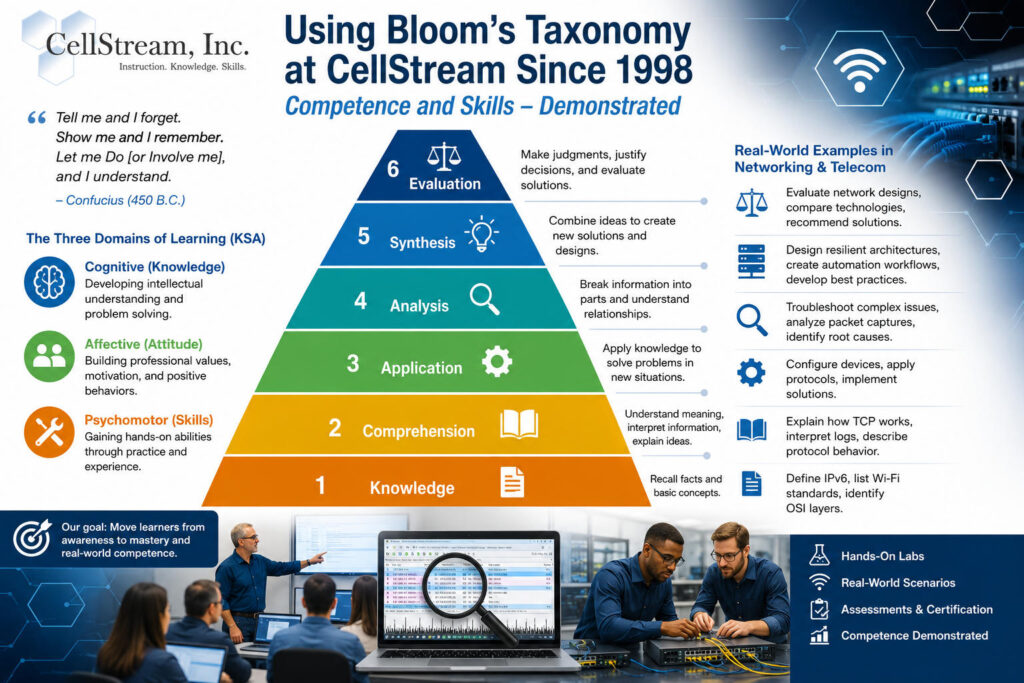
One of the guiding principles at CellStream has always been that learning is only valuable when it results in measurable competence and demonstrable skills. Since our founding in 1998, we have designed training programs around a simple but powerful concept often attributed to Confucius:
“Tell me and I forget. Show me and I remember. Involve me and I understand.”
This philosophy aligns closely with Bloom’s Taxonomy, one of the most respected educational frameworks ever developed. Bloom’s Taxonomy provides a structured methodology for transforming information into knowledge, knowledge into skills, and skills into professional competence.
For more than two decades, CellStream has utilized Bloom’s Taxonomy as a foundation for developing technical courses, certification programs, hands-on laboratory exercises, assessments, and workforce development initiatives for telecommunications, broadband, networking, wireless, and information technology professionals.
Why Bloom’s Taxonomy Matters
Many training programs focus primarily on information delivery. Learners are exposed to concepts, definitions, and terminology, but often leave without the ability to apply what they have learned in real-world situations.
At CellStream, our objective extends beyond knowledge transfer. We focus on developing professionals who can:
- Understand technology concepts and architectures
- Apply technical knowledge to operational environments
- Troubleshoot real-world network issues
- Analyze packet captures and performance data
- Design and improve systems and processes
- Make informed business and technical decisions
Bloom’s Taxonomy helps us build learning experiences that progressively move students from awareness to mastery.
The Three Domains of Learning
Bloom’s framework identifies three primary learning domains:
Cognitive Domain – Knowledge
The Cognitive Domain focuses on intellectual development and understanding. This domain answers questions such as:
- What is IPv6?
- How does Wi-Fi roaming work?
- What is the purpose of MPLS?
- How does TCP congestion control operate?
- What information can be extracted from a Wireshark packet capture?
The Cognitive Domain develops a learner’s ability to understand and reason about technology.
Affective Domain – Attitude
The Affective Domain addresses professional attitudes, values, motivations, and behaviors.
Successful technical professionals require more than technical knowledge. They must demonstrate:
- Customer focus
- Professional ethics
- Attention to detail
- Commitment to quality
- Continuous learning
- Teamwork and collaboration
These characteristics often distinguish exceptional engineers and technicians from average performers.
Psychomotor Domain – Skills
The Psychomotor Domain focuses on practical skills and execution.
Examples include:
- Capturing packets with Wireshark
- Configuring IPv6 services
- Performing RF analysis on Wi-Fi networks
- Using protocol analyzers and test equipment
- Troubleshooting VoIP call quality issues
- Building automation workflows with network management tools
This is where theory becomes operational capability.
Together, these domains form what many training professionals call KSA:
Knowledge + Skills + Attitude = Professional Competence
The Cognitive Domain in Technical Training
The Cognitive Domain contains six progressive levels of learning.
1. Knowledge
Knowledge focuses on recalling facts and information.
Examples include:
- Defining TCP, UDP, and QUIC
- Identifying Wi-Fi frame types
- Listing IPv6 address categories
- Recognizing Ethernet frame fields
At this level, learners know the terminology and concepts.
2. Comprehension
Comprehension requires understanding the meaning behind information.
Examples include:
- Explaining why TCP uses acknowledgments
- Describing how DHCP assigns addresses
- Explaining the purpose of QoS
- Interpreting Wireshark packet details
Students move beyond memorization and demonstrate understanding.
3. Application
Application requires using knowledge to solve practical problems.
Examples include:
- Applying subnetting principles to a network design
- Configuring a wireless network
- Building packet capture filters
- Interpreting throughput measurements
This is where technical professionals begin using knowledge in operational environments.
4. Analysis
Analysis involves breaking complex systems into understandable components.
Examples include:
- Troubleshooting packet loss
- Isolating VoIP call failures
- Determining causes of Wi-Fi performance degradation
- Analyzing packet captures to identify root cause
Many CellStream labs focus heavily on this level because troubleshooting is fundamentally an analytical skill.
5. Synthesis
Synthesis combines knowledge from multiple disciplines to create new solutions.
Examples include:
- Designing an enterprise Wi-Fi architecture
- Developing a troubleshooting methodology
- Creating network automation workflows
- Building operational best practices
This level represents engineering and solution development.
6. Evaluation
Evaluation represents the highest level of cognitive development.
Examples include:
- Comparing competing architectures
- Assessing vendor solutions
- Selecting troubleshooting strategies
- Evaluating network performance against business objectives
At this stage, professionals can justify recommendations and make informed decisions.
The Affective Domain in Technical Organizations
Technology organizations succeed when employees possess the proper attitudes and professional behaviors.
At CellStream, we incorporate affective learning objectives that encourage:
- Professional responsibility
- Ethical decision making
- Customer-focused thinking
- Continuous improvement
- Collaboration and communication
- Commitment to operational excellence
Technical competence without professional discipline often leads to inconsistent results. The most successful professionals combine expertise with strong personal and organizational values.
The Psychomotor Domain in Technical Skills Development
Technical mastery ultimately requires hands-on experience.
This is why CellStream emphasizes:
- Hands-on laboratories
- Packet analysis exercises
- Wireshark investigations
- Troubleshooting scenarios
- Network simulations
- Guided technical exercises
- Real-world operational case studies
A learner may understand TCP theory, but true competence is demonstrated when they can diagnose retransmissions, latency, congestion, or application performance problems in a live packet capture.
Similarly, a technician may understand Wi-Fi concepts, but practical competence is demonstrated when they can identify interference, roaming issues, authentication failures, or RF coverage problems in the field.
Skills are developed through practice, repetition, and guided experience.
How CellStream Applies Bloom’s Taxonomy
Every CellStream learning engagement incorporates Bloom’s principles through:
- Structured learning objectives
- Progressive knowledge development
- Hands-on lab exercises
- Real-world troubleshooting scenarios
- Practical assessments
- Certification examinations
- Performance-based evaluations
Whether we are delivering training on Wi-Fi, IPv6, Broadband Access Networks, MPLS, Ethernet, VoIP, Packet Analysis, Network Automation, or Cybersecurity, our goal remains the same:
To move learners from awareness to understanding, from understanding to application, and from application to demonstrable competence.
Competence and Skills – Demonstrated
Since 1998, CellStream has believed that successful training is measured not by the amount of information presented, but by the capabilities developed.
Knowledge alone is not enough.
Professionals must be able to apply what they know, solve problems they have never seen before, and contribute measurable value to their organizations and customers.
Bloom’s Taxonomy provides a proven framework for achieving those outcomes, and it remains one of the foundational methodologies behind CellStream’s approach to workforce development, technical education, and professional certification.
Because at CellStream, learning is not simply about knowing.
It is about demonstrating competence and skills.